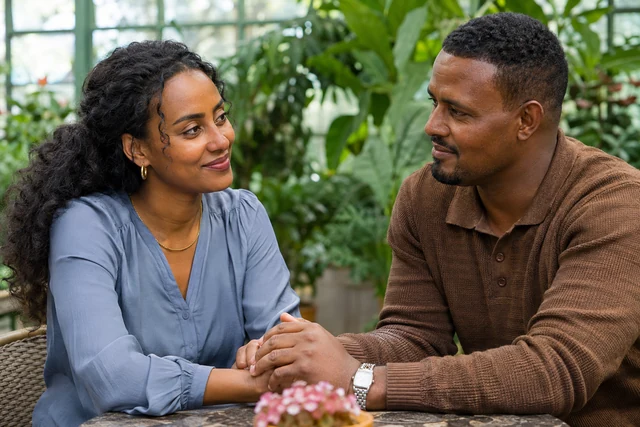
Commitment as the starting point of serious Ethiopian dating
Serious Ethiopian dating starts from the idea that a relationship should lead somewhere, usually to engagement and marriage, and it suits adults who want a lasting partner rather than a passing connection. In Ethiopia, casual dating is not common, and people typically meet a partner with marriage in mind. If you come from a culture where dating can last years without a plan, this difference deserves a clear conversation.
That does not mean every Ethiopian single follows one script. Individuals differ by region, faith, education and family. But many people share a common expectation: when two adults spend time together, others in their circle will ask where it is going.
For you, this means being honest about your own intention. If you are looking for a spouse, say so within the first few conversations, in a calm and friendly way. If you are not sure yet, say that instead of letting the other person assume. A partner who wants marriage will respect a clear answer more than a vague one.
Choosing platforms made for people who want a relationship
Several services say they serve people who want more than casual chat. Gojo is designed for Ethiopian and Eritrean Habesha singles, promotes profile verification and lets members filter by location, age and religion. EthiopianPersonals lists dating, long-term relationship and marriage among its purposes, and it asks members to be single or separated and at least 18. AfroIntroductions lists serious relationships and marriage, and it prohibits fake identities and requests for money.
Muzz is a marriage app for Muslims who are genuinely seeking marriage, with selfie verification and an Islamic conduct pledge. Single Christian adults, whether never married, divorced or widowed, are served by ChristianCafe. Mainstream apps such as Bumble and Tinder also have members who want a relationship, and Bumble lists serious relationships among its purposes.
Prices change, so look at the current price in the app store or on the platform. When you read a profile, look for people who write about their values, work, family and faith in specific terms. Verification shows that an account passed a check, but it does not prove intentions, marital status or honesty.
Profile details that signal a serious intention
State your age range, city, work, religion if it matters to you, and whether you want children. Add a sentence about what a good week looks like for you. These details help the right people find you and keep the wrong ones away.
Faith and the shared life it implies
Religion is often central to a serious relationship in Ethiopia. The 2007 census recorded about 44% Orthodox, 34% Muslim and 19% Protestant, and many observers believe the Muslim and Protestant shares have grown since. Interfaith marriages are generally rare, while interethnic marriages are relatively common. A person who attends church weekly or fasts will probably look for a partner who understands that rhythm.
Orthodox Christians fast on many days of the year, and Wednesday and Friday are weekly fast days. As a rule, alcohol is not drunk by Muslim Ethiopians. If your partner follows a different tradition from yours, ask how they would like to raise children, which festivals the household would keep, and which religious ceremony would be used for a wedding.
Do not treat these questions as a test. Ask them with curiosity and listen to the answer. If you do not share a faith, say what you can offer: respect for the other person’s practice, willingness to learn, and attendance at important ceremonies.
How families enter a serious relationship
In Ethiopian tradition, men and women generally have a say in choosing a partner, but both sets of parents must approve of each other’s families. Parents and elders have strong influence, particularly over decisions concerning women.
The traditional proposal is called shimagile. The groom sends elders, often including a priest, a mutual friend and a respected member of the community, to the bride’s family. They enter, state their purpose and describe the groom’s qualities and family. The bride’s parents may ask about the groom’s occupation, religion, HIV status and habits such as smoking or drinking. Approval is rarely immediate, and family background has traditionally been checked back seven generations. After consent, the couple is officially engaged and a wedding date is set.
Women elders are increasingly sent in some cities, though acceptance is uneven, and customs differ among ethnic groups. Many modern couples blend tradition with personal choice. Ask your partner how their family would like to be introduced to you, and do not assume your own country’s approach is the default.
Meeting parents for the first time
Wear neat clothes, greet the eldest person first and use titles such as Ato, Woizerit or Woizero until invited to use first names. Remove your shoes at the door. If you bring food, it will be appreciated, and gifts should be given and received with two hands or the right hand, not opened on the spot. Avoid giving alcohol as a gift to Muslim or Protestant families.
Practical expectations about work, home and money
Men are typically seen as the main income earners, and men often wait until they have finished school and have a job before marrying. The woman traditionally moves into the husband’s home. These are common expectations, not rules, and many couples today share earnings and decisions.
Raise these topics before the engagement, not after. Ask each other where you plan to live, whether both of you will work, how you would support elderly parents and how you will handle a wedding budget. Weddings may include telosh, a ritual before the wedding at the bride’s parents’ home where the groom and his family give property or money to the bride and guests present gifts. A gown and jewellery are among the gifts that are steadily taking the place of dowries. In rural areas telosh is a larger share of costs.
Muslim marriage has its own framework. A nikah is a contract based on offer and acceptance with free consent, two adult witnesses and a mahr, a gift from the groom to the bride that can be cash, property or goods. Moderation is recommended.
If you plan to marry in Ethiopia, the Revised Family Code of 2000 sets the minimum age at 18 for both women and men, requires free and full consent, and recognises civil, religious and customary marriage. Every marriage must be registered, and a certificate is issued. Civil marriage requires notice at least one month ahead and two witnesses per spouse.
Dating etiquette on the way to commitment
Serious dating has its own manners. The person who invites is expected to pay, and splitting the bill is not usual. If you want to pay, say that you would like to take the other person out, and expect polite resistance. Lateness is tolerated in casual settings, but considerable lateness is unacceptable.
Meals follow customs. Eat with the right hand from a shared platter, using injera to scoop food. Washing hands first is normal. A partner may offer you gursha, a mouthful fed by hand as a sign of respect. Smile and accept.
Physical affection is a sensitive topic. Premarital sex carries a strong stigma, especially for women, and some Muslims prefer not to embrace people of the opposite gender unless they are close family. A handshake should be offered by a man only after the woman has offered her hand. Let your partner set the pace, and never press.
Coffee as an invitation to slow down
The coffee ceremony, buna maflat, can be a gentle sign of closeness when a family invites you. It is served in three rounds, abol, tonna and baraka, and leaving after the first round is inappropriate. Plan an hour or more.
Warning signs and safety while seeking commitment
People who say they want marriage are sometimes targeted by fraud. Be careful if a new contact declares love very quickly, avoids video calls, asks you to leave the platform or asks for money. Anyone who has not been met in person should never be sent money, gift cards or cryptocurrency. Run a reverse image search on profile photos and do a video call before you meet.
A friend should be told where you are, your own transport should be arranged, and the first meeting should be in a public place. Be wary of any partner who hurries a wedding date or an immigration process. Marriage in Ethiopia needs the free consent of both spouses, and consent obtained by violence or fundamental error is invalid.
Respect also applies to your own limits. If a person pressures you, you can leave. Report abusive or fake accounts to the platform and keep screenshots.
Building the relationship step by step
A sensible path might include the following stages, adapted to your own situation:
- Several video or phone calls that cover work, family, faith and plans for children.
- A first meeting in a public place, kept short.
- Introductions to friends, then to parents, in an order your partner suggests.
- A frank conversation about where each person wants to live and what each expects from marriage.
- A formal step such as shimagile or a family visit, if both of you want it.
Every stage can be slowed or paused. A partner who wants to marry you will not mind waiting for you to be ready, as long as the direction is clear.
Remember that couples change as well. A year in, ask each other what has become clearer, and what has become harder. Serious dating is not about perfect agreement, but about honest decisions made by two adults who respect each other’s families, faith and goals.