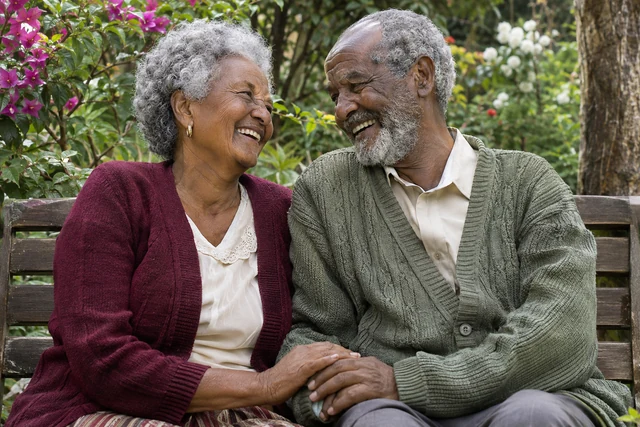
Later-life partnership as an Ethiopian single
Senior Ethiopian dating describes the search for a partner by Ethiopian or Habesha adults who are mature, often widowed, divorced or separated, and who want companionship, a steady relationship or a second marriage rather than a series of casual dates. It covers people living in Ethiopia and members of the diaspora in North America, Europe and the Gulf, and it assumes that everyone involved is an adult who can decide freely.
In Ethiopian society, casual dating has never been the usual route to a partnership. People generally meet someone with marriage in mind, and that habit does not disappear with age. A woman or man of sixty who looks for a companion is usually thinking about a shared home, shared holidays and a person to grow old beside, so the conversation tends to turn to intentions much sooner than on a mainstream swiping app.
Later life also brings a different starting point. Many mature singles already have grown children, grandchildren, a career behind them or a pension, and a clear idea of what they want and what they will not accept. That clarity is an advantage. It lets you write a short, honest profile, ask direct questions and move at a calm pace without feeling pressure to prove anything.
This is also a topic where individual situations differ a great deal. One person is rebuilding after the death of a spouse, another left a long marriage, another has never married. Nobody fits a single pattern, and the best approach is to be clear about your own circumstances and to listen carefully to the other person’s.
Family approval and the role of grown children
Ethiopian courtship traditionally involves both families. Men and women usually have a say in choosing a partner, but the parents on each side are expected to approve of the other family. In the classic form, elders called shimagile are sent by the man to the woman’s family to ask for her hand, often including a priest, a mutual friend and a respected member of the community.
For a mature couple, the family that matters most is often the one made of grown children. A widow with sons and daughters may find that their opinion carries real weight, and a widower may want his children to meet the new woman in his life before any announcement. Introducing the relationship early and calmly, rather than presenting it as a finished decision, tends to avoid hurt feelings.
Talking to adult children
Start with the reasons rather than the decision: you are lonely in the evenings, you enjoy the company of this person, you want their blessing but you are not asking for permission. Adult children often worry about property, inheritance and being replaced in the household. Naming those worries openly is kinder than leaving them unspoken.
Using elders in a modern way
Some families still send elders to open the conversation, even when both partners are in their sixties. Women elders are now sent in some cities, although acceptance is uneven. If a formal approach feels too heavy, a respected relative or a priest or imam who knows both of you can act as a gentle go-between, and the couple then decides what happens next.
Faith, fasting and the rhythm of a mature relationship
Religion often sits at the centre of life for older Ethiopians. The last census gave roughly 44 per cent Orthodox Tewahedo Christians, 34 per cent Muslims and 19 per cent Protestants, and many observers think the Muslim and Protestant shares have grown since. Interfaith marriages are generally rare, so a partner’s faith is rarely a minor detail.
For an Orthodox partner, the calendar shapes daily life. About 180 fasting days apply to every lay believer, including every Wednesday and Friday and the 55-day Lent before Easter, when no meat, dairy or eggs are eaten. A dinner on a fasting day is normally vegan, and a shared platter of dishes such as shembera or lentils is an easy and respectful choice.
A Muslim partner may avoid alcohol and may prefer not to hug people of the opposite sex who are not close family, and a man is advised to wait for a woman to offer her hand before offering his. A Protestant partner may also avoid alcohol. These are good reasons to choose a tea or coffee for a first meeting rather than a drink, and not to bring wine as a gift.
Talking about faith early saves months of doubt. Ask how often the person attends services, whether they fast, who they would want to marry them, and whether they expect a partner to join their church or mosque. Mature singles usually have firm answers, and firm answers are useful.
Which apps and sites suit senior Ethiopian dating
No platform is built only for older Ethiopian singles, so the choice depends on what you want. EthiopianPersonals is a specialist site and app that lists singles in Addis Ababa, Adama, Bahir Dar, Hawassa, Dire Dawa, Gondar, Mekelle and many other places. It accepts members who are single or separated, which fits people in the middle of a divorce, and free members can create a profile, search and read messages from paying members.
Gojo is aimed at Habesha singles, both Ethiopian and Eritrean, and offers filters for religion, age and location plus verified-profile indicators. ChristianCafe is a website for single Christian adults who are never married, divorced or widowed, with a private mailbox and forums, which suits a slower, written style of getting to know someone. Muzz is built for Muslims looking for marriage and requires a selfie check, with an optional chaperone feature.
Mainstream apps such as Tinder or Badoo have far more users, but their culture is quicker and more casual. Tinder charges for Plus, Gold and Platinum tiers, and prices change, so check the current cost in the app store before you commit. Whichever service you pick, begin on the free tier and decide after a few weeks whether the people you meet are the kind you were hoping for.
A practical point for people who are less comfortable with phones: choose a service with a website version, use a large-screen device and ask a trusted relative to help with the first set-up of the profile and privacy settings, not to run it for you.
Writing a profile that fits a mature adult
A good profile for a person in later life is short, specific and warm. Say your age honestly, where you live, your faith if it matters to you, and what a good ordinary week looks like: church on Sunday, a coffee with friends, cooking for grandchildren, gardening, walking, reading. Concrete details attract people who share them.
Use recent photographs. One clear portrait and one photo in an everyday setting are enough, and group photos make it hard to tell which person you are. Avoid photographs with children who are not yours, and avoid anything that shows your house number or your workplace.
State your intention plainly. Words such as companionship, a long-term relationship or marriage tell readers what to expect. If you are widowed, you can mention it in one sentence without turning the profile into a story of grief. If you are divorced, you do not need to explain why.
Finally, describe what you are offering as well as what you are seeking. A line about being a good cook, a patient listener or someone who loves hosting the coffee ceremony helps the reader picture an actual person, and it invites a conversation instead of an interview.
Protecting yourself from romance fraud
Mature singles are targeted by romance fraud, and the losses are large. The FBI’s 2025 internet crime report recorded 23,159 confidence and romance complaints with reported losses of about 929 million US dollars. The pattern is consistent: a charming profile, fast declarations of affection, a request to move to WhatsApp or another private channel, and then an urgent need for money.
Be especially careful with profiles built to win sympathy, such as someone who says they were recently widowed or serve abroad, and with anyone who says they work on a construction project or an oil rig and cannot meet. Warning signs include a person who seems too perfect, never agrees to a video call, asks about your savings or pension, and becomes angry when you ask questions.
Never send money, gift cards or cryptocurrency to someone you have not met in person, whatever the reason. Do not agree to receive money and pass it on for someone else, because that can involve you in money laundering. Run a reverse image search on the photographs and talk to a friend or relative before you act on any request.
If you have been caught, stop all contact, tell your bank at once and report the fraud. In the United States that means the FTC and the FBI’s IC3, in the United Kingdom Action Fraud, in Canada the Canadian Anti-Fraud Centre, and in Australia Scamwatch. Screenshots should accompany your report to the dating platform as well. Shame keeps many people silent, but speaking up quickly is the best way to limit the damage.
Meeting in person and thinking about marriage
Plan the first meeting for daylight, in a public place, with your own transport. A coffee or a lunch is enough. Tell a friend or relative where you will be, keep your phone charged and feel free to leave without a long explanation if you are uncomfortable. If you are meeting someone who lives abroad, insist on several video calls before anyone buys a plane ticket.
If the relationship deepens, learn the legal basics. In Ethiopia marriage can be civil, religious or customary, both people must freely consent, the minimum age is 18, and every marriage must be registered whatever its form. A civil marriage requires a month’s notice and two witnesses for each spouse. Remarriage is barred for a woman until 180 days after her previous marriage ends, with listed exceptions, and divorce happens either by mutual consent accepted by the court or through a court petition.
Because mature couples often own property and have children from earlier marriages, it is sensible to speak to a lawyer in the country where you plan to live before the wedding, and to agree openly on who will care for whom as health changes. Customary events such as the telosh gift ritual a few days before the ceremony, the melse evening party and the kelekel family gathering afterwards can all be scaled down if both families agree.
Above all, take the time you need. Companionship in later life works best when it rests on shared daily habits, honest talk about health and money, and the support of the people who love you both.