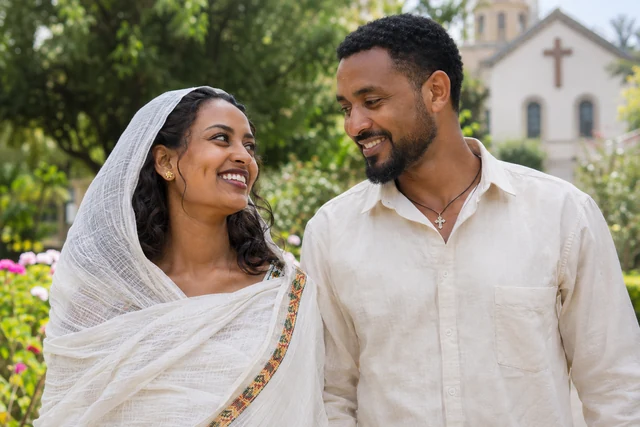
Christian traditions among Ethiopians and why they matter in dating
Christian Ethiopian dating means looking for a partner who shares your Christian faith and your Ethiopian background, whether you belong to the Orthodox Tewahedo Church, a Protestant church or the Catholic Church. Faith is not a side detail for many people in this search. It shapes the weekly calendar, the food on the table, the form of the wedding and the way families judge a match.
The figures explain why. The 2007 census, the most recent in Ethiopia, gave 44 per cent of the population as Orthodox, 34 per cent as Muslim and 19 per cent as Protestant, with Catholics and followers of traditional faiths together under 5 per cent. Many observers believe the Muslim and Protestant shares have grown since then. Christianity became the state religion of Ethiopia in the year 333, and the Tewahedo church is one of the earliest Christian traditions in Africa.
Regional patterns
Tigray and Amhara are mostly Orthodox, while parts of Oromia, Gambella and the former Southern region have many Protestants. A person’s tradition is therefore often tied to the place where the family comes from, and a partner from a different region may bring a different church culture even within Christianity.
Pew data quoted by Cultural Atlas show that 87 per cent of Ethiopians say they fast during holy times and 78 per cent say they attend church weekly. For a single Christian, that suggests that an easy way to understand a potential partner is to ask how they live their faith week by week.
Orthodox Tewahedo faith: fasting, church and weddings
Fasting is central to Orthodox life, with about 250 fasting days a year, of which about 180 are obligatory for everyone and the rest apply to clergy. On a fast day, no meat, milk products or eggs are eaten. Wednesday and Friday are weekly fast days, a rule that is lifted for the 50 days from Dagme Tensae, the Sunday after Easter, until Pentecost. Lent, called Abiy Tsom, is the longest continuous fast and lasts 55 days.
For a date, this has a simple meaning: a Wednesday or Friday meal with an Orthodox partner is normally vegan, and a shared fasting platter of lentils, chickpeas and vegetables is the usual choice. Typical Lenten dishes include siljo, shembera and lentils with fenugreek. When the Easter fast is broken, families share doro wot, a spicy chicken stew with boiled eggs.
Entering the church and the wedding service
Orthodox churches are entered without shoes. Orthodox weddings are held in church, early in the morning, sometimes around six o’clock, with three priests, incense and a long service in Amharic in an older religious form. The couple wear heavy robes with gold-stitched flowers and crosses and matching fabric crowns. Dagme Tensae marks the start of the main wedding season.
If you are invited to a church ceremony by a date’s family, ask a friend about dress and customs, and arrive on time. Your respect for the setting will be noticed.
Protestant, Pentay and Catholic believers
Pentay refers broadly to non-Orthodox Protestants, and most members are former Orthodox Christians. Major denominations include Kale Heywet, known as Word of Life, the Ethiopian Evangelical Church Mekane Yesus, Mulu Wongel, which means Full Gospel, and Meserete Kristos. The Mekane Yesus church, in the Lutheran family, became a national church in 1959, and the World Council of Churches lists about 8.3 million members, nearly 4,000 pastors and more than 8,500 congregations.
Protestant life differs from Orthodox life in many ways. Church weddings usually start around ten or eleven in the morning, later than Orthodox weddings. Cultural Atlas advises against giving alcohol as a gift to Protestant or Muslim Ethiopians, so choose flowers, sweets or coffee instead. Ask a Protestant partner how their own church marks times of prayer, since the Orthodox fasting calendar does not apply to everyone.
Catholic and other Christian partners
Catholics form a small minority in Ethiopia, under one per cent in the 2007 census. A Catholic reader looking for a Christian Ethiopian partner may find fewer matches by religion filter and will need to be flexible about denomination or active in a parish.
Whatever your church, say clearly in a first conversation which tradition you belong to and how often you attend. A partner who understands your practice will be better prepared to share it.
Christian Ethiopian dating apps and websites
Gojo Ethiopian Dating is a mobile app for Ethiopian and Eritrean Habesha singles, and it includes a religion filter and verified-profile indicators. EthiopianPersonals combines a website and an app, with Ethiopian-focused profile search and location filters. ChristianCafe, a website, is intended for single Christian adults who are never married, divorced or widowed. Free-trial users can browse and communicate but with limits on contact information, and features include Christian profile matching, a private mailbox, forums and prayers. It is an option for Ethiopian Orthodox, Protestant and Catholic singles abroad, and users choose their country when they register, with an Other Country option.
Mainstream apps help too. Tinder, Bumble and Badoo are for adults only, and a note in your bio about your church or your wish for a Christian partner can save time. AfroIntroductions and InternationalCupid reach people abroad. Prices change, so check the current cost before you pay.
What to write in the profile
Name your tradition, say how important church is in your week and state whether you want a partner who shares it. Avoid slogans. One concrete sentence, such as how you spend Sunday, tells a reader more than a list of beliefs.
Verified badges show that an account passed a check, but they do not prove sincerity. Take your time.
Courtship, families and the blessing of elders
Casual dating is not common in Ethiopia, and people usually meet a partner with marriage in mind. Men and women generally have a say in choosing, but both sets of parents must approve of each other’s families. Shimagile is the custom by which elders sent by the groom visit the bride’s family to propose; they usually include a priest, a mutual friend and a high-status member of the community. They describe the groom’s qualities, and by custom they stand until approval is given.
The bride’s parents ask about the groom’s work, religion, HIV status and habits such as smoking or drinking. The family deliberates in private, and approval is rarely instant. After consent, the couple are officially engaged and the wedding date is set. Women elders are increasingly sent in some cities, although acceptance is uneven.
Before the wedding
Telosh, a ritual at the bride’s parents’ house a few days before the wedding, involves gifts from the groom’s family and guests, and gifts such as a gown and jewellery increasingly replace dowries. After the wedding come Melse, an evening party with close family, and Kelekel, a gathering where extended family bless the couple.
Customs vary by ethnic group and between town and countryside. Treat these as a guide and ask your partner what their family expects.
Sharing faith on dates: practical habits for Christian couples
Faith can enter a relationship gently. Suggest attending a service together once you know each other, introduce your partner to your priest or pastor when the relationship is serious, and ask about prayer habits without pressure. Respect differences between denominations. An Orthodox and a Protestant partner may disagree on the form of worship, and a patient conversation will help more than a debate.
Plan meetings around the calendar. Avoid fast days when you choose a restaurant if you are unsure, or pick a place with good vegetable dishes. Do not schedule an evening date for a time when your partner is in church. Show understanding for Lent and for holy weeks, when many believers are especially strict.
Interfaith questions
Interfaith marriages are generally rare in Ethiopia, while marriages across ethnic groups are relatively common. If your partner is Christian but from a different church, or not Christian, discuss how you would raise children, which services you would attend and how both families would react. Begin early and listen carefully.
Local churches and mosques often help the community in hardship, and a partner who is active in such help shows a character that many people value.
Safety, honesty and respect for adults only
All dating described here concerns adults of 18 and over. Ethiopian family law sets the minimum age of marriage at 18 for both women and men, and it requires the free consent of both spouses. Anyone who pressures a person to marry, or who targets a minor, is acting against the law and against the faith they may claim.
A shared faith does not guarantee honesty. Scammers use religious language to win trust. Be wary of someone who quotes scripture in the first message, declares that God has chosen you, asks you to leave the dating site for a private messenger and then needs money for a hospital bill, a ticket or a visa. Never send money, gift cards or cryptocurrency to someone you have not met in person. A pastor or priest you trust can give advice if you are unsure.
First meetings
Meet in a public place, tell a friend where you will be, arrange your own transport and hold a video call beforehand. A short first meeting is enough. If you are harassed or threatened, report the person to the platform and to the police.
Christian Ethiopian dating works best when honesty, patience and family respect guide each step.