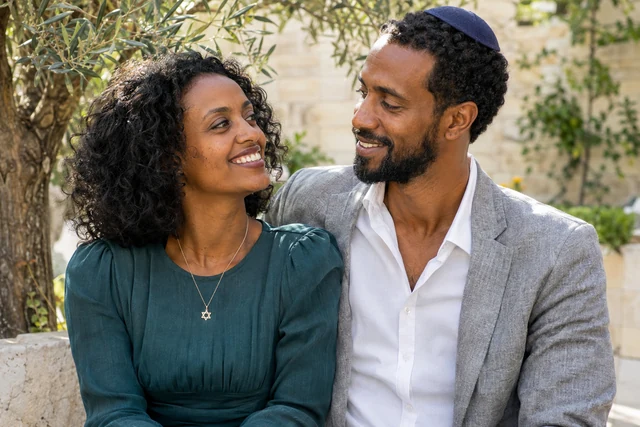
Beta Israel heritage and Jewish Ethiopian dating
Jewish Ethiopian dating brings together adults from the Beta Israel community, their Israeli-born descendants and partners who share or respect their heritage, whether they meet in Israel or in the diaspora. The community has a long Ethiopian history and a recent chapter in Israel, and both shape how people think about family, faith and belonging.
The Ethiopian Jewish community is known as Beta Israel. Between 1977 and 1984 about 8,000 people reached Israel in small airlifts. Operation Moses in 1984 and 1985 brought another 8,000, and Operation Solomon on 24 and 25 May 1991 airlifted 14,325 people in 36 hours. For many families these journeys are living memory, and they are often part of the story told on a first meeting with parents.
Israel’s Central Bureau of Statistics counted 177,600 Israelis of Ethiopian origin in 2024, compared with 171,600 in 2023, when 54 percent of them had been born in Ethiopia. That means a large share of Jewish Ethiopian singles today were raised in Israel and may know Ethiopia mainly through family stories, food and music.
Different generations, different experiences
A person who was born in Ethiopia and arrived as a child has a different background from one who grew up entirely in Israel. Ask open questions about their upbringing instead of assuming. Some people want a partner who shares Amharic or Tigrinya and the home traditions; others care more about shared values, and some seek both.
Sigd and other occasions that bring families together
Sigd is the annual Ethiopian Jewish holiday. It falls on 29 Heshvan, fifty days after Yom Kippur, and its name refers to prostration in Ge’ez. Customs include fasting, readings from the Octateuch and the Psalms, prayers for the rebuilding of the Temple and a renewal of the covenant. At midday the fast is broken, and a shared meal with dancing follows. In 2008, Sigd became an official state holiday in Israel.
For a person who wants to understand a Jewish Ethiopian partner, Sigd is a good topic. Ask what it means to the family and how they celebrate. In 2024 the national celebration was held on 28 November at the Armon Hanatziv Promenade in Jerusalem, and the holiday is marked across Israel. An invitation to join a family at Sigd is a sign of trust.
Other Ethiopian customs also appear in Jewish Ethiopian households, such as the coffee ceremony, served in three rounds, and the shared platter eaten with injera. Ethiopian restaurants and music are now common in Israel. Respect for elders matters: greet the eldest first, and expect them to be served first at meals.
Family, community and expectations in Jewish Ethiopian dating
As in many Ethiopian families, parents and elders often play a large part in how a couple is judged. Marriage is seen as the joining of two families, so be ready to be asked about your parents, your work and your plans. These questions express care and not distrust, and honest answers are always better than evasive ones.
Community organisations support many families. The Ethiopian National Project brings together organisations assisting the Ethiopian-Israeli community and works in cities including Netanya, Petah Tikva, Tel Aviv, Afula, Tirat Carmel, Be’er Sheva, Kiryat Yam and Lod. It also runs education programmes for Ethiopian-Israeli students. Events run by such organisations are a natural way to meet people through shared interests.
The community’s early years in Israel also included painful moments. The Israeli Rabbinate once required early immigrants to undergo a symbolic conversion immersion, a requirement that was abolished in 1985 after a month-long strike. People who remember this history may be sensitive to questions about who counts as Jewish. Avoid asking a partner to prove their background, and let them tell their story at their own pace.
If you are not Jewish, say so openly and ask what your partner and family would expect. Questions about conversion, observance, children and holidays are serious, and a patient conversation is wiser than guessing.
Where to meet Jewish Ethiopian singles
Dating services built only for Jewish Ethiopian singles are hard to find, so many people use general or Ethiopian-focused services. Gojo is designed for Ethiopian and Eritrean Habesha singles, with filters for location, age and religion that let a member state a faith. Tinder, Badoo and Bumble are widely used by adults in Israel and abroad, and OkCupid offers detailed compatibility questions and relationship intentions.
Check the rules and prices on each platform before you pay, since subscriptions renew automatically until cancelled in the phone settings. Photo or selfie verification shows that an account passed a check, but it does not prove marital status or honesty. Search for a person’s name and photos elsewhere before you trust the story.
Offline, friends and relatives remain a central route. Community events, holiday gatherings, universities and workplaces bring people together, and an introduction from a mutual friend lets both families learn about each other early. In Israel, cities with active Ethiopian-Israeli organisations have many opportunities for such meetings.
Dating in Israel: local rules and sensitivities
Israeli law does not criminalise same-sex relations between consenting adults, and dating between adults is unrestricted. The UK government nevertheless notes that in some ultra-Orthodox areas public affection may draw negative attention. In neighbourhoods such as Bnei Brak and Beit Shemesh, less conservative dress, especially on women, may provoke strong reactions, so plan a meeting place with that in mind.
A first meeting in a cafe, a park or a busy public place works in Israel as elsewhere. Arrange your own transport, tell a friend where you are and keep personal details private until you know the person. If you are visiting, learn about the places you intend to go and the customs of each neighbourhood.
Remember that Jewish Ethiopian singles are individuals. Some are religious and some are secular, some grew up in Israel and others arrived as children. Ask what matters to them and respond with interest and not with assumptions drawn from a headline.
Jewish Ethiopian dating abroad and across borders
Many people of Ethiopian origin live outside Israel, and some Jewish Ethiopians travel for study or work. Bumble, with Travel Mode and Incognito Mode, is popular among diaspora members in North America, the United Kingdom and Europe. International platforms such as InternationalCupid and AfroIntroductions let members search across borders, though they are not designed for any one faith.
Long-distance relationships need clear plans. Agree how often you will speak, when you will meet and what each of you expects in the next year. If marriage becomes a goal, learn the visa and residence rules of the country where you hope to live; the United States, the United Kingdom and Canada each have family routes with requirements on proof of relationship, finances and language.
Be wary of anyone who asks for money before meeting. The FBI recorded 23,159 romance and confidence complaints in 2025, with losses above 929 million dollars. Never send funds, gift cards or cryptocurrency to a person you have not met in person. If you are deceived, tell the platform, keep screenshots and report to the relevant fraud service in your country.
Building trust across cultures and faiths
A relationship between a Jewish Ethiopian and a partner from another background asks for patience on both sides. Learn the basics of the heritage: the airlifts, the holiday of Sigd, the Ethiopian food and the languages spoken at home. Show interest without turning your partner into a representative of the entire community.
Talk about practical matters in good time: where you would live, how you would celebrate holidays, which languages the children would hear and how often you would see relatives. Disagreements are easier to settle before an engagement than after.
Above all, let trust develop at its own speed. Meet the family when the relationship is ready, accept hospitality warmly and give the same openness you ask for. A partner who feels respected for who they are will usually respond in kind.