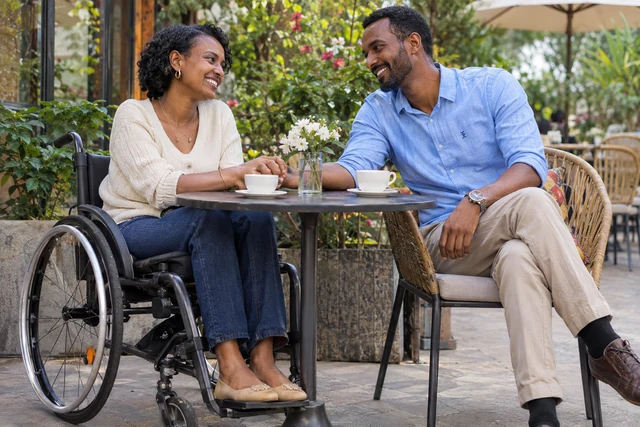
What accessible dating means for Ethiopian singles with a disability
Ethiopian dating for disabled singles refers to the ways in which adults with a physical, sensory, intellectual or chronic condition meet partners within Ethiopian communities at home and abroad. It covers online profiles, introductions through family and friends, community events and first meetings that suit a person’s needs. The aim is not a special kind of romance. The aim is the same as for anyone else: a partner who respects you and a meeting that works for your body and your daily life.
Disability is not one experience. A wheelchair user, a deaf person, a person who is blind, a person with a long-term illness and a person with a learning difficulty each face different questions. Nobody should speak for all of them, and nobody should assume what a disabled adult wants. Each person decides what to share, when to share it and with whom.
Dating in Ethiopian culture also has its own pace. Casual dating is not common, and many people meet a partner with marriage in mind. Parents often have a say, and both families tend to want to approve of each other. A disabled adult may meet this with pride, with worry or with both. Planning ahead makes the conversation easier.
Adults decide for themselves
Everything here concerns adults, aged 18 or over. Under the Revised Family Code of Ethiopia, a valid marriage needs the free and full consent of both spouses, and a person who is pressured or deceived into marriage can challenge it. Consent belongs to the person who is marrying, not to relatives or carers. That principle applies equally when someone needs help with daily tasks.
Writing a profile that explains your needs without apology
A profile for Ethiopian dating for disabled singles does not have to start with your condition. Begin with who you are: your work or studies, your languages, your faith if it matters to you, your favourite food and the kind of relationship you want. Then decide whether to mention your disability and how.
Some people prefer to name it in the profile, so that anyone who contacts them already knows. Others prefer to say it in the first conversations. Both choices are valid. What matters is that you say it before a first meeting, particularly if the venue, the transport or the timing depends on it.
Choosing the words
Plain statements work best. You can write "I use a wheelchair and I like cafés with step-free entrances", or "I am deaf and I prefer written messages or video with captions". Use the terms you are comfortable with. A short sentence about what helps you is more useful than a long explanation.
Photos
Use recent photos. A photo that hides part of you can raise questions later and may cause hurt at a first meeting. You owe nobody a medical history, but you gain trust by showing yourself honestly.
Finding Ethiopian dating for disabled singles through apps
Several services are designed for Ethiopian and Eritrean singles. Gojo Ethiopian Dating is a mobile app for Habesha singles with chat, matching, filters for location, age and religion, verified-profile indicators and an Incognito Mode. Its rules prohibit fake accounts, nudity and harassment. EthiopianPersonals is a website and app where users must be at least 18 and single or separated.
For people living abroad, mainstream apps such as Tinder, Bumble and Facebook Dating are options. They are for adults only. Facebook Dating is free of charge and keeps its profile separate from the main Facebook profile. Prices vary on other apps, so check the current price in the app store before you subscribe.
Features that can help
Some features are useful when you want control. Incognito or private modes show your profile only to people you have liked. Filters let you narrow the search to people in your city, which matters if you need accessible transport. Blocking and reporting tools help you end contact quickly. Read the settings of each app and test them before sharing your details.
Accessible first meetings: place, time and transport
Plan the first meeting around your needs. Ask your match to choose between two or three places that you have checked in advance. If you need step-free access, a quiet room, good lighting or a seat near the door, say so beforehand and ask the person to confirm. A short first meeting of an hour is enough.
A public place is the right setting, and it is best to remain there. Get to the venue and back by your own means, and tell a trusted person where you are. You are not obliged to go anywhere private or to stay longer than you wish. If the meeting is not going well, you can leave without giving a reason.
If you need support from a carer or friend
You may bring a friend or relative who waits nearby, or you may attend with an assistant. Say so openly. A respectful match will understand. Someone who reacts with contempt has shown you something important early.
Communication needs
Deaf and hard-of-hearing people can suggest a text chat first, then a video call with captions, and then an in-person meeting. People who are blind can ask for a description of the venue and an offer of an arm only if they want it. People with speech difficulties can propose written messages. State what you need in a calm sentence and let the other person respond.
Family, community and faith in introductions
In Ethiopian communities, family is often involved. Parents and elders strongly influence decisions about partners, and marriage merges two families. Local churches and mosques often help to mobilise community support in hardship, and they can be a place to meet people who know your family.
If you are Orthodox, Muslim or Protestant, a community leader may know of other singles. You decide how much to say. You may ask a trusted relative to make an introduction and to explain your needs in advance, so that the first meeting is calm.
Traditional steps and your say
Traditionally, a man sends elders to the bride’s family to propose, in a custom called shimagile. They describe the groom’s qualities, and the bride’s family asks about occupation, religion and habits. If you are a woman with a disability, you can ask your family to tell the elders what you want. If you are a man, you can prepare your own account of your life and work. In both cases, your voice should count.
Talking to parents who worry
Some parents worry about who will care for a disabled child when they are gone. Others fear gossip. Speak about your plans and ask them to meet your partner early. Calm, practical conversations reduce fear better than arguments.
Online safety and avoiding people who exploit loneliness
Fraudsters look for people who are hopeful and isolated, and disabled adults can be targeted like anyone else. The common pattern is fast affection, a request to leave the dating app, a story that prevents meeting and then a request for money for medical bills, travel, visas or fees. Money, gift cards or cryptocurrency must never be sent to a person who has not been met face to face.
Be careful with profiles built to win sympathy, such as a person claiming to be recently widowed or serving in the forces. Do a video call before meeting, run a reverse image search on the photos, and search the name with the word "scam". Do not send intimate photos to a person you do not know.
Protecting your information
Share your address and workplace only when you trust the person. Ethiopia has a Personal Data Protection Proclamation, No. 1321 of 2024, which gives people the right to be informed, to access their data, to ask for corrections or erasure and to object to processing. If you leave a dating app, you can ask the company to delete your data, and you should cancel any store subscription separately.
Handling disrespect and moving forward
You may meet people who ask intrusive questions or treat you as a duty. You do not have to educate them. You can end the conversation, block the profile and report it to the platform. Tell a friend if a message hurts. A pause is acceptable.
Respect works both ways. If you are a non-disabled person who wants to date a disabled Ethiopian adult, ask what helps, listen to the answer and do not assume. Do not treat disability as heroic or tragic. Treat the person as a partner, with preferences, humour and opinions.
When a relationship grows, plan practical matters together: where you will live, who will help with which tasks, and how both families will be involved. Honest planning is a sign of commitment, and it gives both partners confidence.