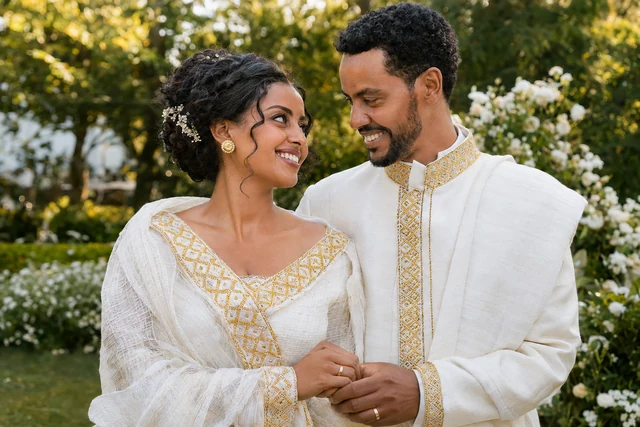
Marriage intentions in Ethiopian relationships
Ethiopian marriage is the union of two adults that is recognised by law and by their families, whether it is concluded before a civil officer or under religious or customary rites, and it is usually the goal that gives a relationship its direction from the first meeting. Casual dating is not common in Ethiopia, and people generally look for a partner with marriage in mind. Someone who tells you early that they want a family is not rushing you; they are following a widely shared expectation.
Men and women usually get a say in picking a partner, yet the two sets of parents each have to approve the other’s family. Marriage is seen as the merging of two families, and the woman traditionally moves into the husband’s home. Men often wait until they have finished school and have a job before they marry. Parents and elders strongly influence decisions, particularly for women, and men are typically seen as the main income earners, although many couples now share these roles according to their circumstances.
Talking about intentions without pressure
If you are unsure whether the person you are seeing wants marriage, ask plainly and kindly. A message such as asking what they hope for in the next few years gives them room to answer honestly. Share your own intentions in return. Clarity at this stage prevents hurt later, and it is more respectful than hoping the other person will guess.
Premarital sex carries a strong stigma, especially for women, so it is wise to ask your partner about their own boundaries and to respect them. Doing so is part of showing serious intent. Everything in dating concerns adults aged 18 and over, and each person is entitled to set their own limits.
The legal forms of Ethiopian marriage
The Revised Family Code of 2000, Proclamation 213, recognises three ways to marry. A marriage may be concluded before a civil officer, under the religion of the spouses or under the custom of their community. A civil marriage is concluded when the officer accepts the couple’s consent, with notice given at least one month ahead and two witnesses for each spouse. A religious marriage is concluded by the acts or rites that the religion of one or both spouses treats as valid. A customary marriage rests on rites that the community’s custom treats as valid.
Several rules apply whatever form is chosen. Both spouses must give free and full consent, and each must personally consent at the time and place of the celebration. Consent obtained by violence or fundamental error makes the marriage invalid. Neither person may marry before 18, although the Minister of Justice may grant a dispensation of up to two years for a serious cause. Bigamy is prohibited, as is marriage between certain close relatives and in-laws. A marriage must be registered whatever its form, and a certificate is issued.
Two further points are good to know. Remarriage is not permitted for a woman until 180 days after her previous marriage ends, apart from listed exceptions. Divorce is by mutual consent accepted by the court or by petition to the court, and mutual-consent divorce is not available for marriages under six months.
The law and daily life do not always match. A 2016 survey cited by Cultural Atlas found that 40 per cent of girls were married before 18, so the legal age is not always enforced. Any couple planning a marriage, in Ethiopia or abroad, should check the current requirements with the relevant registry or a lawyer, especially when one partner lives in another country.
Orthodox, Protestant and Muslim wedding ceremonies
Ethiopian weddings differ by faith. Orthodox ceremonies are held in church, early in the morning, sometimes around 6 am. Three priests lead a long service with incense, in an older religious form of Amharic. Matching fabric crowns and heavy robes embroidered with gold flowers and crosses are what the couple wear. Guests remove their shoes before entering the church.
Weddings in other churches usually start later, around 10 or 11 am. Protestant denominations include Kale Heywet, the Ethiopian Evangelical Church Mekane Yesus, Mulu Wongel and Meserete Kristos, and each has its own practices. The Mekane Yesus church, for instance, was established as a national church in 1959 and describes the Old and New Testaments as the basis of its teaching.
A Muslim marriage is built on the nikah, which means to bind and is mandatory for validity. Among Muslims in Gonder it is often called aqid. It is a solemn social contract based on an offer, called ijab, and an acceptance, called qubul, with the free consent of both sides. Two adult witnesses are required and the contract is announced publicly. The mahr is a gift from the groom to the bride, which can be cash, property or goods, paid at the marriage, deferred or split, with moderation recommended. A study of the nikah in Gonder found that its procedures have changed over ten years because of cultural and economic pressures.
Telosh, melse and kelekel around the wedding
The wedding is surrounded by smaller gatherings. A few days before it, the telosh is held at the bride’s parents’ house. Property or money is given to the bride by the groom and his family, and gifts are brought by guests. Over time, gifts such as a gown and jewellery have increasingly replaced the dowry. In rural areas, telosh can make up a larger share of the costs.
On the wedding morning the bride is dressed at a close relative’s home among female relatives and friends, with singing and dancing, while the men gather with the groom. This separation gives each side its own celebration before the two come together for the ceremony.
Afterwards, melse is an evening party three days after the wedding, where the couple wear traditional outfits and only close family attend. A few days later kelekel brings the extended family together, and the parents congratulate and bless the couple. For a guest or a new in-law, being invited to one of these events is a sign of acceptance.
The wedding season and the Ethiopian calendar
Timing follows the religious year. The main wedding season begins on Dagme Tensae, the Sunday after Easter, when the long Lent fast has ended and the weekly Wednesday and Friday fasts are lifted for fifty days. Couples who marry in the Orthodox tradition do well to check the fasting calendar with the priest before they fix a date.
The calendar itself can cause confusion. The Ethiopian year has twelve months of 30 days and a thirteenth month of five days, or six in a leap year. It runs eight years behind the Gregorian calendar from January to September and seven years behind from 11 September to 8 January. When you agree a wedding date with relatives, confirm which calendar they mean, particularly if guests are travelling from abroad.
Enkutatash, the new year on 11 September, and Meskel, on 27 September, are also times when families gather, so ask your partner whether those days are family occasions for them. Check with your partner which dates matter most to their family before planning travel.
Two families, household roles and expectations
Because Ethiopian marriage merges two families, expectations reach beyond the couple. Parents may expect to be consulted on housing, on work and on children. Elders are greeted first, served first at meals and given the first cup of coffee. A new spouse who shows these courtesies builds trust quickly.
Roles in the home are changing. Women are expected to offer help to the female host when preparing and cleaning up, a custom that many families still value, while many couples now divide tasks according to their jobs. In the diaspora, partners often work in similar fields and share the household, so it is best to discuss money, housework and family visits openly before the wedding instead of relying on assumptions.
Ask each other practical questions. Who will support relatives at home, if anyone? How often will you visit? Which language will you speak with the children? Ethiopia has 87 native languages, with Amharic the only language with official status nationwide, so a couple from different language groups may need to choose carefully.
Regional variation, faith and marriage across borders
Customs differ significantly between ethnic groups. The largest groups in the 2007 census were the Oromo at 34.5 per cent, the Amhara at 26.9 per cent, the Somali at 6.2 per cent, the Tigray at 6.1 per cent and the Sidama at 4 per cent, alongside Gurage, Welaita, Hadiya, Afar and others. Rural weddings often begin earlier with ritual activities. A couple from two different groups should ask each family what is customary and avoid assuming that one family’s way is the only one.
Faith adds another layer. Interfaith marriages are generally rare in Ethiopia, while marriages between ethnic groups are relatively common. A couple of different faiths should ask a priest, imam or pastor what is needed and should consider a civil marriage in addition to a religious ceremony.
For marriages that cross borders, plan the paperwork early. Registration, certificates and the requirements of the country where you will live all matter. Seek advice from the registry or a lawyer, and keep original documents safe. Marriage is a happy event, but it is also a legal act with lasting consequences.
- Confirm the minimum age, consent and registration rules before choosing a date.
- Ask both families about the customs they expect.
- Check which calendar and which fasting periods affect the date.
- Keep certificates and registration papers in a safe place.